On the face of it, Bournemouth against Nottingham Forest looks fairly straightforward. The hosts are slight favourites, the match is expected to produce goals, and you'd naturally expect the strongest Bournemouth players to be the interesting ones.
But if we stop at the match odds, we miss a lot of the football. That's the point of this collaboration with NetArbs odds comparison: two approaches to the same fixture can tell us different, complementary things. Their companion analysis will unpack what the market prices mean. We're interested in what happens inside those possible match outcomes — and which players are likely to benefit.
What the market can tell us — and what it can't
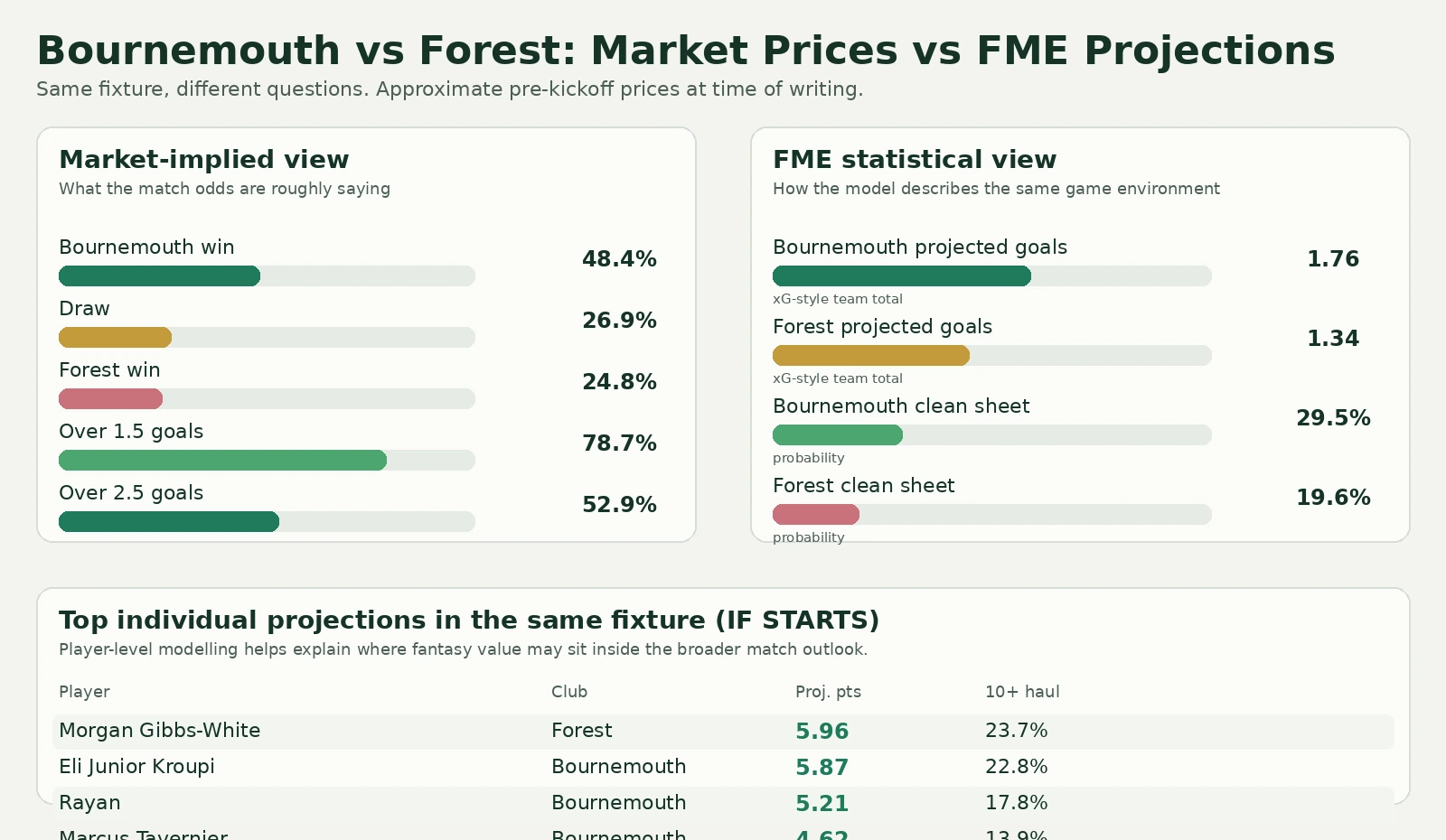
At the time of writing, the approximate prices available for this fixture are 2.00 for a Bournemouth win, 3.60 for a draw and 3.90 for Forest. Over 1.5 goals is around 1.27; over 2.5 goals around 1.89. These are indicative quotes, not a final matched set from a single bookmaker.
That's a useful starting point. Bournemouth are favoured, and a multi-goal match is plausible. But a match-winner price doesn't tell us whether a Bournemouth winger will find space to shoot, whether a midfielder will spend the afternoon making key passes, or whether a Forest attacker can still have an excellent individual game in a defeat.
Nor are bookmaker prices pure probabilities. A price of 2.00 has a raw implied probability of 50%, but margins need to be considered before treating any market quote as a fair probability. And comparing a goal-total price with an FPL points projection is not comparing the same thing at all. That's where the market explanation from NetArbs and the player analysis from FME sit alongside each other rather than competing.
How FME gets from a fixture to a player projection
Our starting point isn't a player's last five FPL scores, or simply that Bournemouth are favourites. We build a statistical action profile for each player: shots, shots on target, chances created, penalty-area entries, passes, tackles, interceptions and the other actions that make up their football.
Then we ask three further questions. Where does this player operate? A wide creator and a central striker don't face the same matchup. What does his own team tend to supply? You need attacking moves before you can generate shots or chances. And what does the opponent tend to allow to that type of player, operating in that role and area of the pitch?
Those pieces remain separate, and smaller samples are treated cautiously. Recent performances matter, but one good afternoon shouldn't wipe out the rest of a player's profile.
Market odds do matter to FME, too. They help shape the expected scoring environment: plausible team goal totals, clean sheets and scorelines. The model then gives more relevance to comparable historical match situations and simulates the fixture 100,000 times, connecting player goals and assists to the simulated team scores rather than letting impossible combinations pile up. The result is an expected FPL score and a range of possible outcomes. You can read the full method in How Our Model Works.
Bournemouth: several ways into the game
And this is where Saturday's example gets interesting. Our GW11 FPL predicted points board shows a cluster of Bournemouth names with respectable projections rather than just one outstanding player.
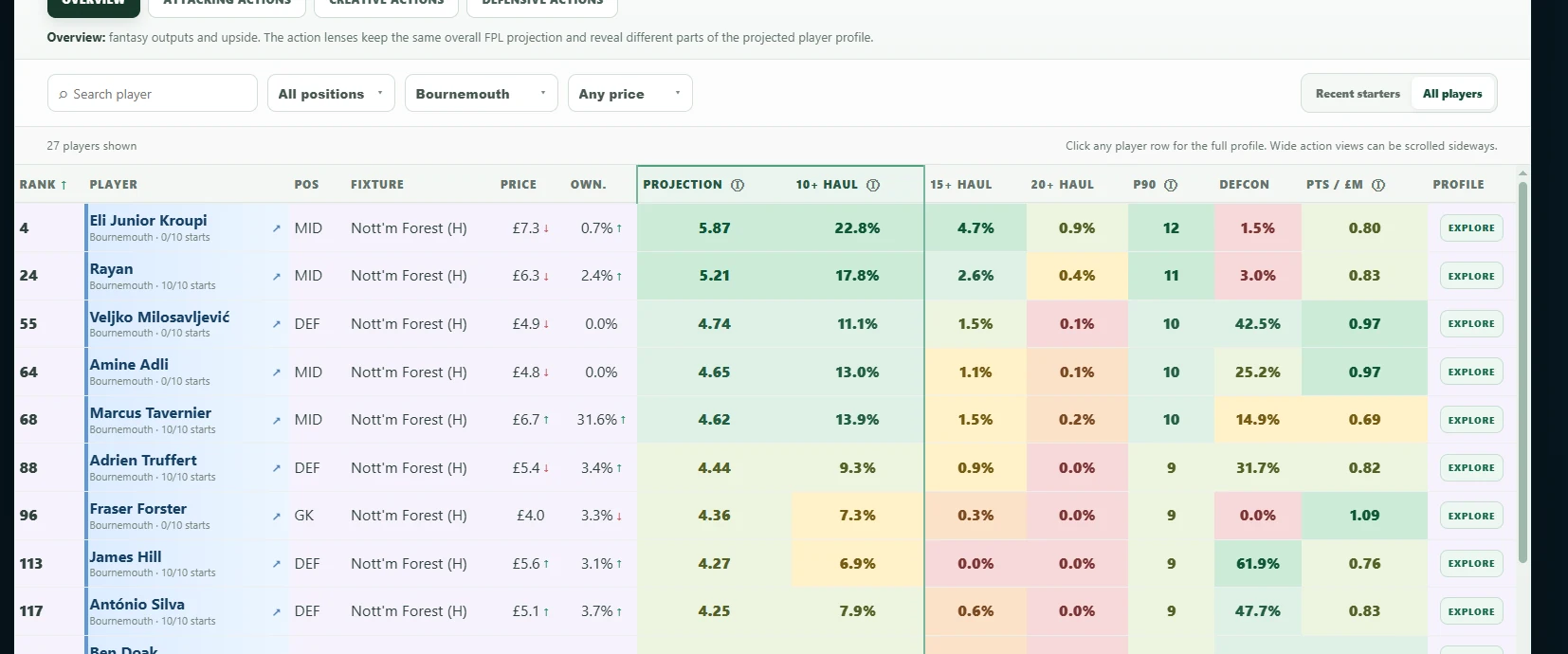
Eli Junior Kroupi sits fourth across the entire league on 5.87 projected points, with a 22.8% chance of a 10+ FPL haul. Rayan ranks 24th on 5.21, with a 17.8% haul chance. Bournemouth also have Veljko Milosavljević (4.74), Amine Adli (4.65) and Marcus Tavernier (4.62) in the top 70.
There is a very important distinction, though: Kroupi, Milosavljević and Adli show 0 starts in the last 10 league matches in the FME snapshot. Those projections describe their potential if selected, not a prediction that they will suddenly all be named in the XI.
Tavernier is a useful worked example of the other side of that distinction. He has started 10 of the previous 10 league matches, is projected for 4.62 FPL points, and carries a 13.9% chance of 10+ points against Forest. His 14.9% DEFCON probability is another small part of the picture. The overall number isn't sensational — but the player's role, actual playing record and different ways of earning points matter more than simply spotting a green fixture.
Our new FPL player pages let you inspect Tavernier's longer-term stats, current action profile, fixture-by-fixture outlook and similar historical match environments, rather than judging him only by the headline projection.
Forest: one very interesting exception to the odds narrative
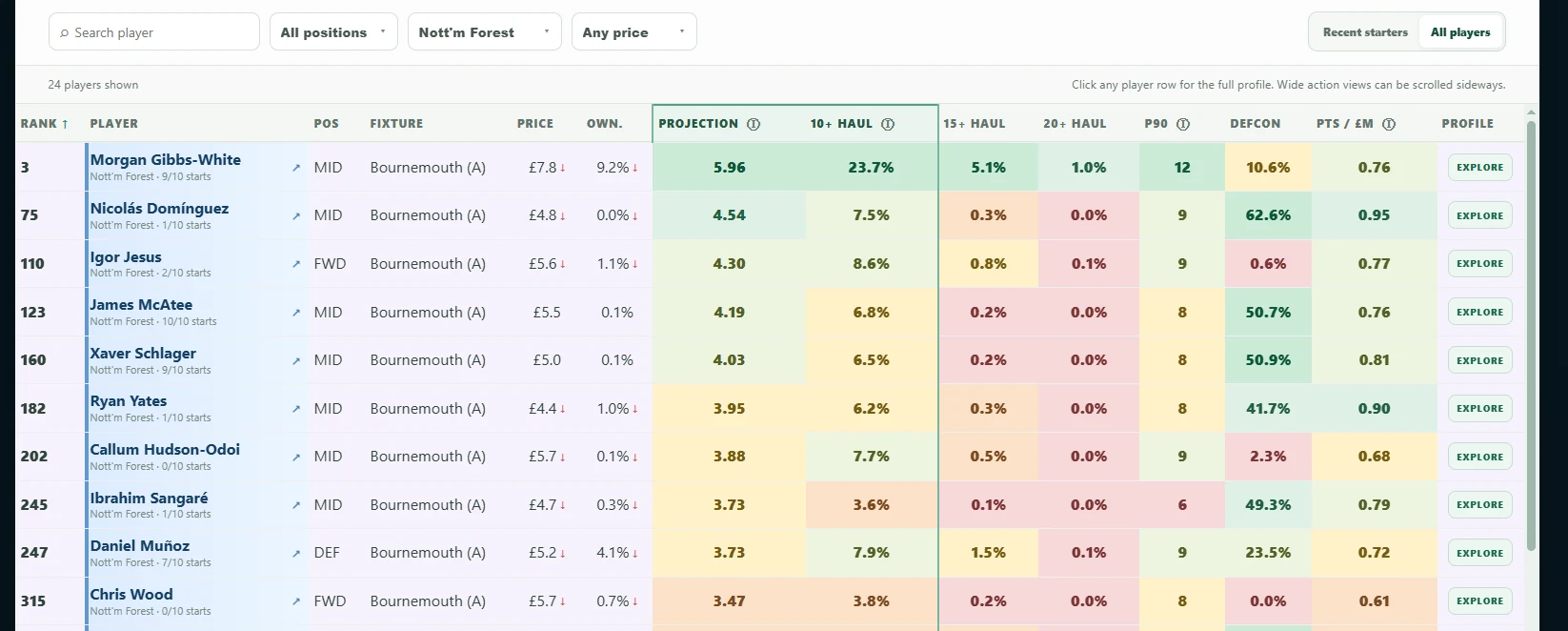
Forest, by contrast, have a single major standout: Morgan Gibbs-White is third in the entire GW11 FME ranking, at 5.96 projected FPL points and a 23.7% chance of 10+. That is despite Bournemouth being the favourites to win the match.
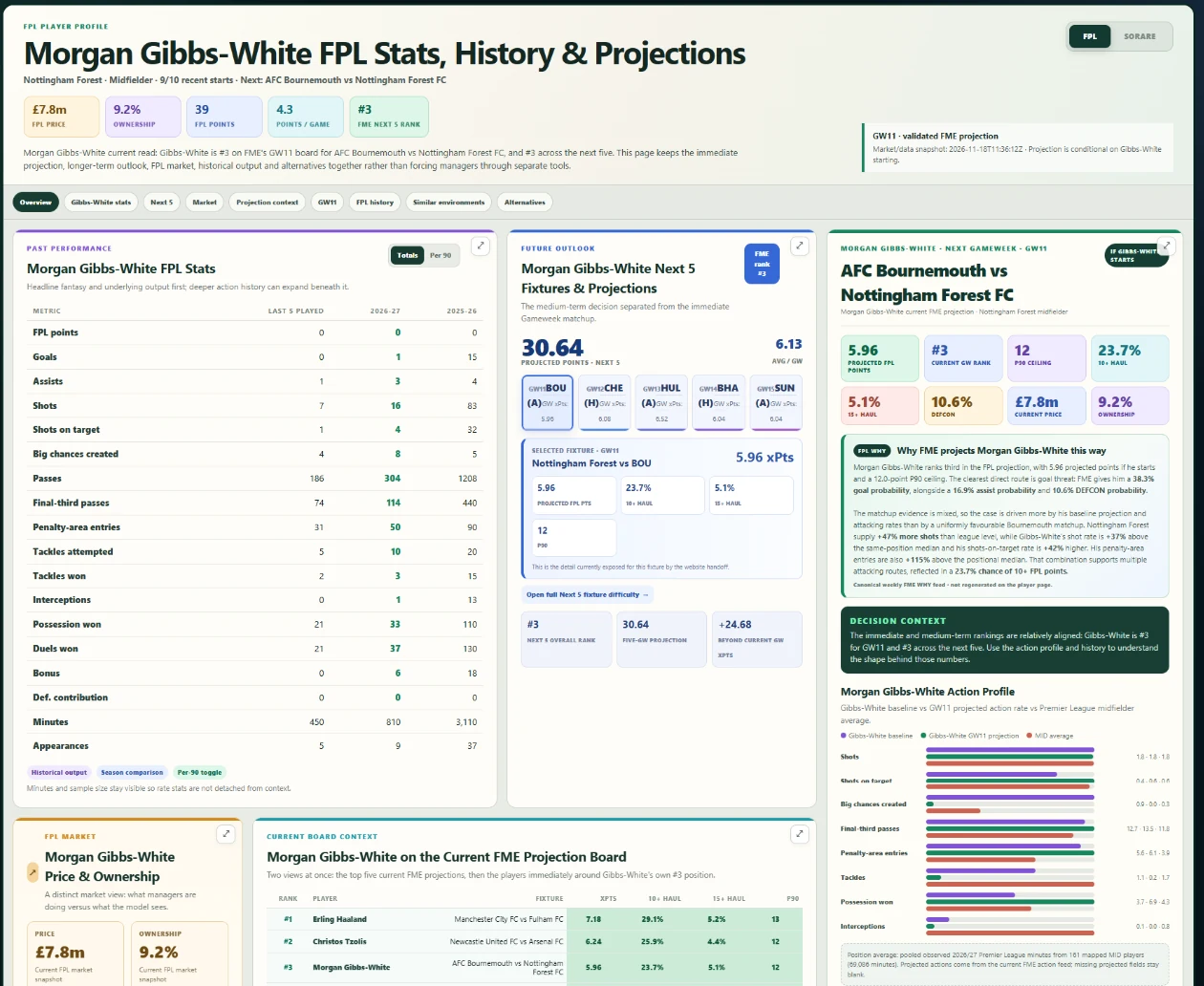
His FME WHY explanation is particularly revealing. It gives him a 38.3% goal probability and 16.9% assist probability. Forest's shot supply is projected 47% above the league baseline, while Gibbs-White's own shot rate is 37% above his positional median and his shots-on-target rate 42% higher. These are reasons to be interested in his involvement, not a claim that Forest are secretly favoured to win.
In fact, the explanation explicitly describes the matchup evidence as mixed. His strong forecast comes more from his underlying attacking profile and team supply than from a blanket Bournemouth defensive weakness. An underdog can still have the best projected individual player in a game. That's exactly the kind of detail a team-level market cannot spell out on its own.
The useful question isn't “which number wins?”
Our own clean-sheet estimates put Bournemouth at 29.5% and Forest at 19.6%. Those same model outputs imply roughly 1.76 projected goals for Bournemouth and 1.34 for Forest. They are model outputs built partly from market-derived information, not a wholly independent set of prices to pitch against the bookmakers.
And everything on the player board is explicitly IF STARTS. We don't multiply a player's football projection by a speculative start probability or a generic expected-minutes estimate. Selection and injury risk need to be checked separately. That keeps the question clean: how good is the player's matchup if he starts? It does not mean he is certain to start or play 90 minutes.
So the odds offer a sensible picture of Bournemouth's advantage and the likely scoring environment. FME takes that context and asks a more personal question: which player actions might this particular match create? Those are different questions, and neither answer is a crystal ball.
Our friends at NetArbs will handle the market mechanics — implied probabilities, margins and the final odds comparison — while you can investigate each player on our FPL projections board. No betting tips required. Just two ways of understanding the same football match.