The short version
If you already understand FPL, you already understand a lot of the football. What changes in Sorare is how players score, how often you can use them, how you build a squad, and the fact that the players in your gallery are cards you actually own.
The biggest mental shift is simple: stop asking only “who is most likely to get a return?” and start asking “what is this player likely to do in this particular match?”
An experienced FPL manager can open Sorare and immediately recognise half the game — fixtures matter, minutes matter, roles matter, form matters, and picking the right player before everyone else still feels very good. The other half is different enough that some familiar FPL instincts can actively get in the way.
This guide is for people who already know their Palmer from their price rise and their xGI from their wildcard. It is not another full introduction to Sorare; if you want that first, start with our What Is Sorare? guide. This is the bit that answers: what changes when an FPL player moves into Sorare?
1. You are not building one season-long £100m squad
FPL starts with a £100m budget, a 15-player squad and a season-long management problem. You own a fantasy slot in a squad; if you transfer a player out, he is gone and you move on.
Sorare is built around a gallery of player cards. You buy a card, keep it, use it in eligible competitions, and can sell or trade it later. The same card can remain useful over multiple seasons, although competition eligibility changes as cards move from In-Season to Classic.
That makes squad building feel much more like building a collection of football assets than filling 15 temporary positions. You may buy one player because he has a brilliant next month, another because he is underpriced, and another because he gives you access to a competition you could not otherwise enter.
The market is part of the game. Prices move. That is fun if you like scouting and value-hunting, but it also means the value of a card can fall as well as rise. Treat spending as hobby money, not guaranteed investment capital.
2. The scoring system is much deeper than FPL
This is the biggest difference in how you evaluate players.
FPL scoring is deliberately compact. Goals, assists, clean sheets, saves, bonus, cards and defensive contributions do most of the work. That simplicity is part of its appeal, but it means a player's fantasy relevance can be heavily tied to a small number of headline events.
Sorare scores players from 0 to 100 using a Decisive Score plus a much wider All-Around Score. Passing, tackles, interceptions, duels, chances created, possession actions and other match events all matter. A player can have an excellent Sorare game without scoring or assisting.
That immediately changes the player pool. A defensive midfielder who feels almost irrelevant in FPL can become a premium Sorare option. A ball-playing centre-back can score strongly because he dominates possession and defensive actions. A goalkeeper facing pressure can pile up saves even without a clean sheet.
If you are coming from FPL, one useful rule is: do not mentally convert every player into “goal threat + assist threat + clean sheet”. Those still matter, but Sorare rewards the football happening between the headline moments as well.
Sorare publishes the full official football scoring guide if you want every action and value.
3. “Good fixture” means something different
FPL fixture thinking often starts with team-level questions: how likely is the clean sheet, how many goals might this team score, and is the opponent green or red on an FDR chart?
Sorare asks a more interesting question because so many more actions are rewarded: what type of game is this likely to become, and which players are likely to be busy in the right ways?
A difficult away game might be poor for a centre-back's clean-sheet chances but excellent for clearances, tackles and interceptions. A dominant home favourite might create huge passing and chance-creation volume for a midfielder while leaving its defenders with very little defensive work. Two players from the same team can therefore face the “same fixture” and have completely different Sorare matchups.
This is also why traditional DFS-style defence vs position numbers only go so far. Knowing that a team allows an average score of X to midfielders is useful background, but midfielders do not all play the same role or score in the same way.
Our Sorare Projections & Rankings go much deeper: player action profile, role and channel, team supply, what the opponent allows, expected match environment and 100,000 simulations of the fixture.
4. You can play twice a week — and you do not have to wait for August
FPL is a 38-Gameweek Premier League season. If your season starts badly, you can recover, but the overall-rank story is still anchored to that one campaign.
Sorare Football usually runs Game Weeks from Tuesday to Friday and Friday to Tuesday. European matches, domestic league fixtures and international windows can all create playable slates. That means more decisions, more lineups and more fresh starts.
It also means there is no equivalent of “I missed Gameweek 1, so there is no point starting now”. You can join when you like, build a small gallery and start entering eligible competitions immediately.
For an FPL player who enjoys the research more than the once-a-week deadline, that extra rhythm is a major part of the appeal.
5. Five players can be enough
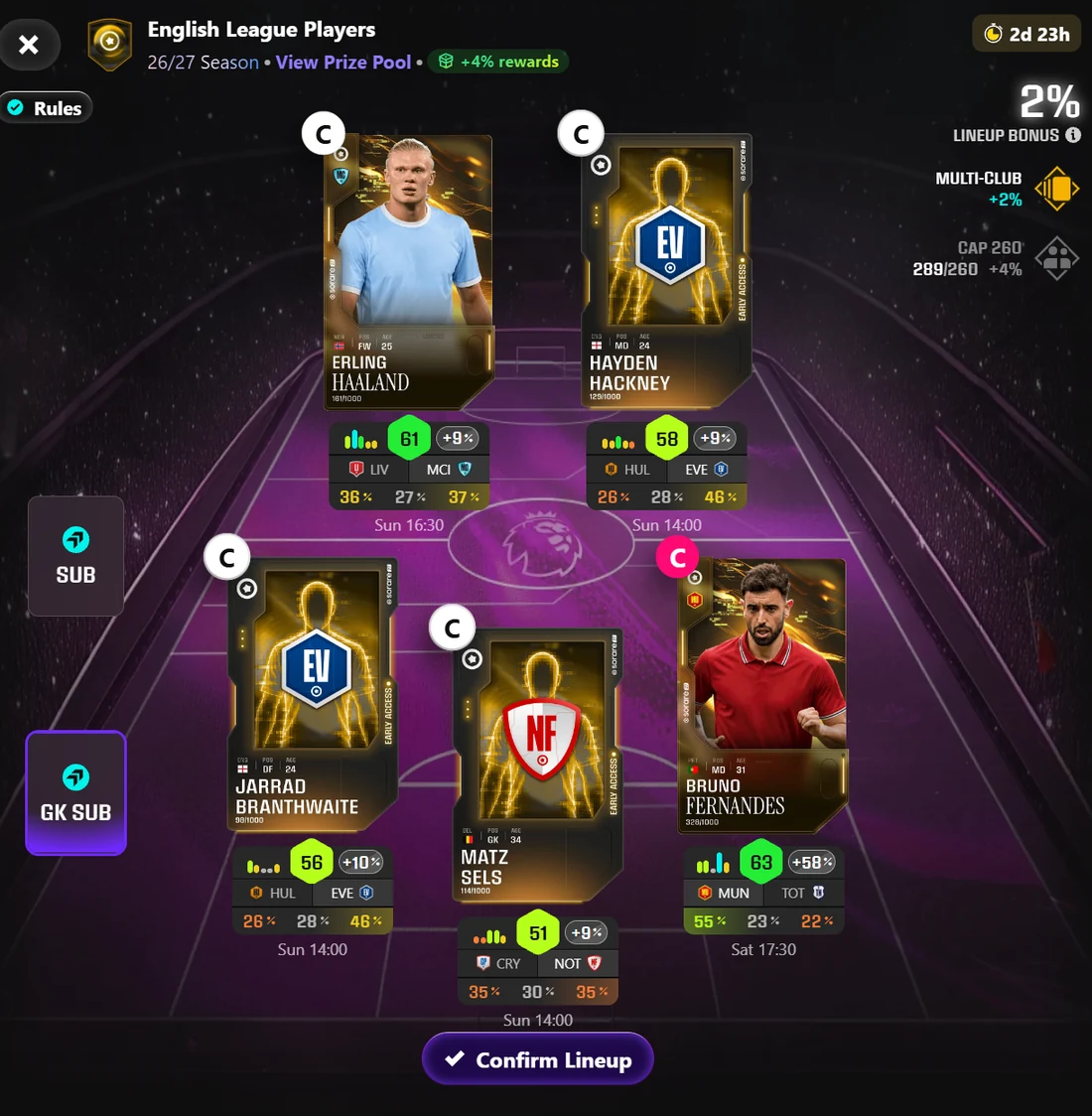
Sorare's current football structure includes Arcade, Arena and Pro. In In-Season Arena and Pro, the normal lineup is five cards: goalkeeper, defender, midfielder, forward and an extra outfield player. Classic competitions can use different lineup rules, including seven-player formats.
The practical difference is that every slot is more concentrated. You do not have an 11-player starting XI to smooth out one bad choice. A single DNP or disastrous score can hurt a lot.
That makes team news, rotation and role security especially important. FPL managers already understand that problem; Sorare simply turns the volume up.
6. There is no universal “best player” — eligibility matters
In FPL, every active Premier League player sits inside one shared game with the same basic squad rules.
In Sorare, cards have scarcity, season and competition eligibility. Limited, Rare, Super Rare and Unique cards occupy different parts of the ecosystem. Current-season cards can unlock In-Season prize pools, while older Classic cards are generally cheaper and have their own competitions.
So a transfer decision is not only “is this player good?” It can also be “does this card help the competitions I actually want to enter?”
That sounds complicated at first. In practice, it becomes one of Sorare's strengths because you can build around your own budget and interests rather than everybody being forced into the exact same game.
Minutes are everything.
A brilliant projection is useless if the player never gets on the pitch. Rotation, injuries and likely starts remain crucial.
Stop chasing only returns.
Goals and assists still matter, but Sorare can reward a strong 90-minute performance even when the player never appears in the FPL returns column.
Think in player archetypes.
How does this player create score? Passing? Defensive volume? Chances? Saves? Decisive actions? The matchup should be judged against that route.
7. There are real prizes — and real card prices
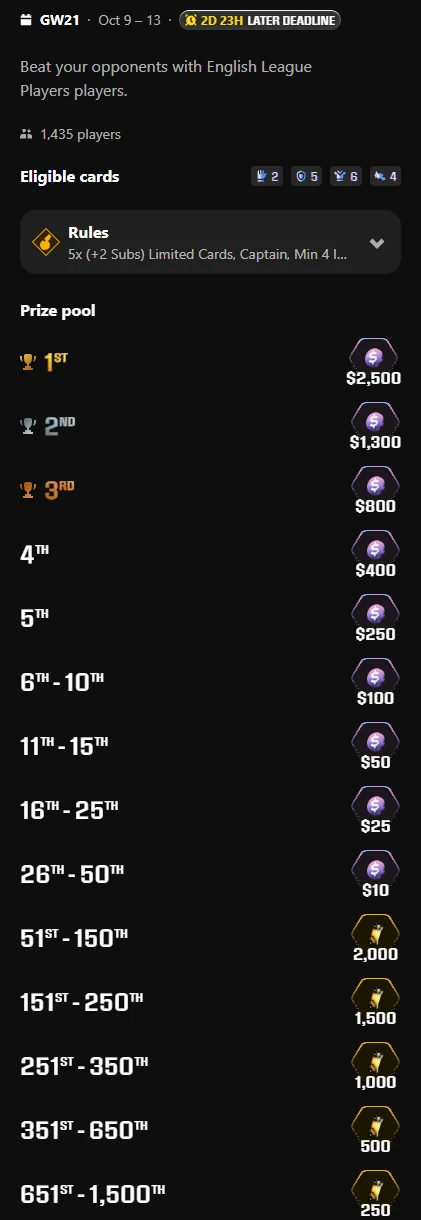
FPL is free and its main currency is rank, mini-league bragging rights and the official season prizes. Sorare has a much more direct reward economy. Depending on the competition, rewards can include cash, cards, Essence and special prizes.
That is exciting, but it should not be dressed up as guaranteed income. To play the deeper paid-card game you generally need to buy cards, and those cards have a market value that can move sharply.
You also do not need to spend hundreds to find out whether you enjoy it. Card prices change constantly, but at the cheaper end a fun Classic or budget Limited setup can sometimes be assembled for roughly £25–£30. It will not contain five superstars, which is rather the point: scouting cheaper players is part of the game.
8. The community feels different
FPL's biggest advantage is scale. It has more than 11 million players, enormous media coverage and a mini-league culture that makes it easy to share with friends who are only casually interested in football.
Sorare's community is smaller and more fragmented because it spans leagues, scarcities, markets and different competition types. You are less likely to discover that every person in the office has a Sorare team.
The trade-off is that the ecosystem is deeper. There are managers specialising in Ligue 1, youth prospects, goalkeeper markets, Classic cards, Limited competitions, trading, collecting and dozens of other niches. If you enjoy going down football rabbit holes, Sorare gives you many more rabbit holes.
9. Your FPL knowledge is still valuable
None of this means starting again from zero. Knowing who is nailed, who is changing role, which teams are improving, which managers rotate and which players are genuinely good is still a major advantage.
The important thing is to add another layer. In FPL, a midfielder with limited goal involvement may be easy to ignore. In Sorare, that same player may average 60 because he wins duels, completes passes, creates chances and recovers the ball constantly.
Think of FPL knowledge as your football base and Sorare scoring as a new lens over the top of it.
Where should an FPL player start?
- Learn the scoring before buying stars. Spend ten minutes with the official scoring matrix and look at the types of players who score well without decisive actions.
- Pick one competition you understand. If you know the Premier League, stay in the Premier League initially. There is no prize for becoming a K League expert on day one.
- Start small. Build one sensible lineup, watch a Game Week play out and decide whether the extra depth actually appeals to you before expanding the gallery.
For the full mechanics — card scarcities, Arena, Pro, Essence, In-Season and Classic — read What Is Sorare?. If you are already at the player-selection stage, head straight to our Sorare Projections & Rankings.
FPL experience gives you a head start. The trick is not to make Sorare behave like FPL. Keep the football knowledge, then widen the way you think about how a player can score.