If you’re a seasoned FPL fan — or even if you’re not — there’s a decent chance you’ve heard the name Sorare without ever really working out what it is. You should probably know about it. I’ve played it for around five years and, personally, I’ve always found it a more immersive fantasy game than FPL. And yes: there are serious prizes available too.
This isn’t some tiny side project hidden away in a corner of the internet. Sorare says it has more than 3 million users across 180 countries, more than 300 partners, and has raised $769 million. But it can still be confusing the first time you open the site. There are cards, scarcities, Arena, Pro, Classic, In-Season, Essence… and it is not immediately obvious which bits actually matter.
So this is the version I wish somebody had given me at the start: what Sorare is, how you actually play it, what the cards mean, how the scoring works, and what you realistically need to spend. No crypto lecture. No “quit your job” nonsense.
And one useful thing straight away: you can start whenever you want. Sorare isn’t a season-long draft where arriving in October means you’ve missed the boat. If your FPL team is currently languishing in 29th place in your mates’ league, this can be a pretty good antidote.
Sorare in 30 seconds
- You collect and own limited digital player cards.
- Your players score from their real-life performances.
- Most In-Season lineups use five players: GK, DEF, MID, FWD and one extra outfielder.
- Arena is the player-v-player leaderboard side; Pro is about beating fixed score targets; Arcade is the free/casual entry point.
- You can buy and sell cards, keep them across seasons, and use them repeatedly while the player remains eligible.
So what exactly is Sorare?
At its core, Sorare is a global fantasy football game built around player cards that you actually own. It covers the English top flight and a large number of leagues around Europe and the rest of the world. You can go deep on global football if you want to; you can also stick almost entirely to English players if that’s your thing. You do not have to become an expert in the Belgian league because a website told you to.
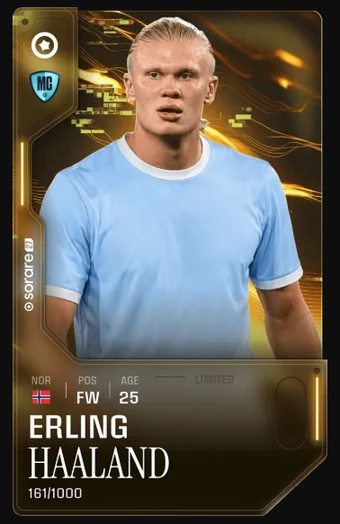
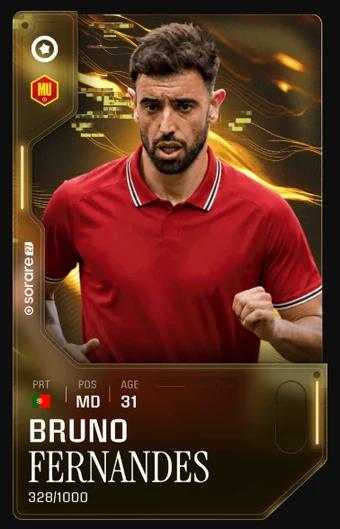
Sorare’s cards are blockchain-backed digital collectibles — yes, technically NFTs — but you do not need to understand crypto to play. The easiest way to think about them is this: you own a specific numbered edition of a footballer. Other managers can own the same player, but there is a fixed seasonal supply of each scarcity.
There are four main Pro-card scarcities: Limited, Rare, Super Rare and Unique. The seasonal supply is capped at 1,000 Limited cards per player, 100 Rare, 10 Super Rare and one Unique. The scarcer cards are more expensive and open different competitions and reward structures.
The elephant in the room: yes, the cards cost money
There are free ways to play, and the current Arcade mode gives newcomers a genuine way to learn the basics. But this guide is mainly about the part of Sorare I find most compelling: owning cards and using them in Pro and Arena competitions.
Limited is normally the sensible entry point. Prices vary massively by player, form, utility and time of season. When I checked while writing this, a current-season Bruno Fernandes Limited was around £55, while useful cheaper players could be found for only a few pounds. Those numbers will move — sometimes quickly — so treat them as examples, not price targets.
The upside is that the cards remain yours. You can keep them, use them repeatedly, or sell them later. You are not paying a fresh cash entry fee every time you submit a normal lineup; your main cost is building the eligible card collection in the first place. Some specialist formats can use in-game currencies such as Essence, so “everything is always free to enter forever” would be too broad a claim.
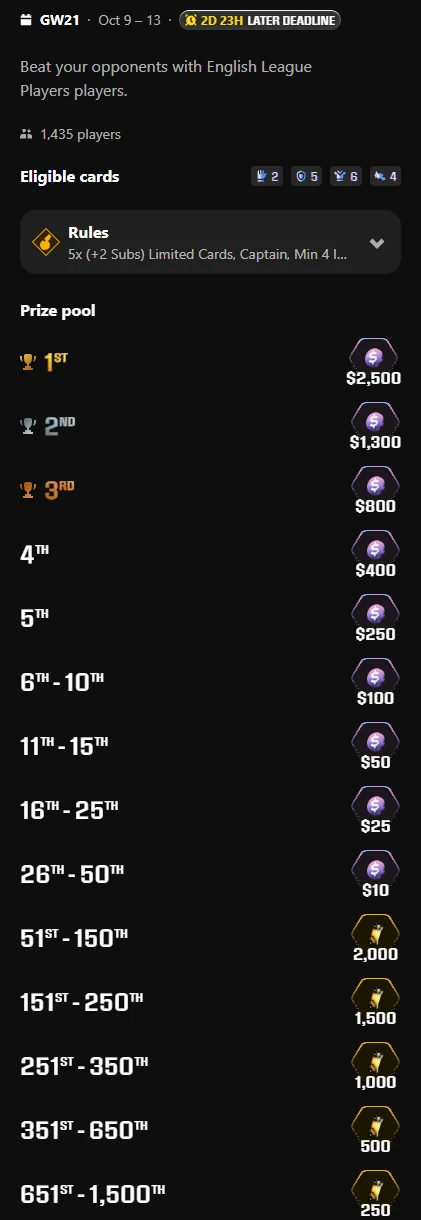
And the prizes can be meaningful. In the English League Players Limited Arena shown below, first place paid $2,500, 10th paid $100, and rewards continued much further down the standings in cash or Essence.
How do you actually play Sorare?
Sorare Football is now organised around three broad modes: Arcade, Arena and Pro. That sounds like another layer of jargon, but the distinction is actually useful.
The free/casual side. Useful for learning the scoring and lineup mechanics without buying a Pro-card collection first.
Player-v-player leaderboards. Your lineup score is ranked against everyone else in that competition.
Hot Streak-style boards where you try to clear fixed score thresholds rather than finish above thousands of other managers.
Arena: build a lineup and take on everyone else
Arena is the most familiar fantasy-sports format. You select a lineup, your players score from what they do in real matches, and your total competes against other managers on a leaderboard.
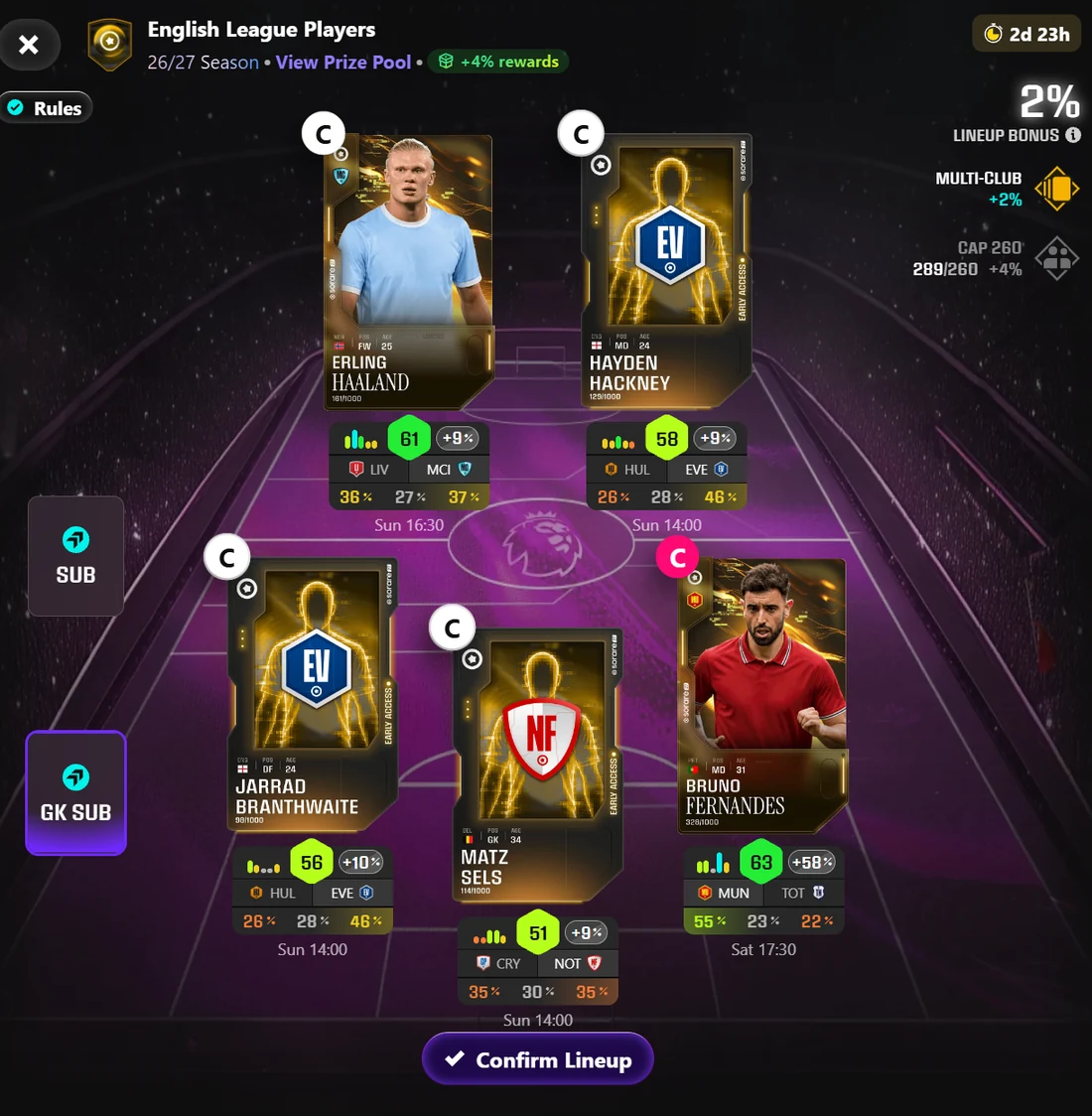
In-Season lineups use five players: one goalkeeper, one defender, one midfielder, one forward and one extra outfield player. Current In-Season rules generally require at least four current-season cards, with one Classic slot available. Classic Arenas use seven-player lineups instead.
Sorare Football runs on a bi-weekly rhythm, with Game Weeks normally spanning Tuesday-Friday and Friday-Tuesday. That means your cards can matter twice in a normal week. There are league-specific competitions for major leagues, broader competitions covering multiple leagues, and international utility when eligible players are involved for their national sides.
You can also submit multiple lineups in many competitions. So a larger gallery eventually gives you more ways to play — but you can start with a single usable team.
The scoring is the bit that hooked me
This is probably my favourite part of Sorare. It does not just wait for goals, assists and clean sheets. Sorare gives players a score from 0 to 100 based on a much wider range of real match actions.
Goals and assists are still enormously important, but so are completed passes, tackles, interceptions, duels, chances created, penalty-area entries, possession lost and plenty more. The scoring combines Decisive Actions with an All-Around Score, so players can reach strong fantasy scores in very different ways.
That changes how you watch football. A high-volume defensive midfielder can be genuinely valuable. N’Golo Kanté used to be fantastic in Sorare without needing to score every week. A centre-back can rack up points from defensive work and passing. A creative midfielder can have a monster game without appearing on the Premier League goalscorer list.
It also makes matchup analysis far more interesting. You are not just asking “will this player score?” You are asking what kind of actions is this opponent likely to create, and which players are best placed to benefit? That is exactly the question behind our Sorare Projections & Rankings.
If you want the full official breakdown, Sorare publishes its football scoring guide and scoring matrix.
Buying, selling and building a gallery
Because you own the cards, there is a marketplace as well as a fantasy game. You can buy players, sell them later, trade around your squad and gradually build a much larger gallery. Some managers are heavily focused on the market side; others barely trade and mostly care about winning competitions.
Card prices move with demand, form, age, injuries, transfers, competition utility and the usual market psychology. That can be fun if you enjoy scouting, but it is also another reason not to treat a card purchase as guaranteed profit.
The nice part is that there is no requirement to build a giant collection on day one. Five good In-Season cards can get you started. Over time, rewards and cheaper Classic cards can open more routes.
Essence: earn your way into more cards
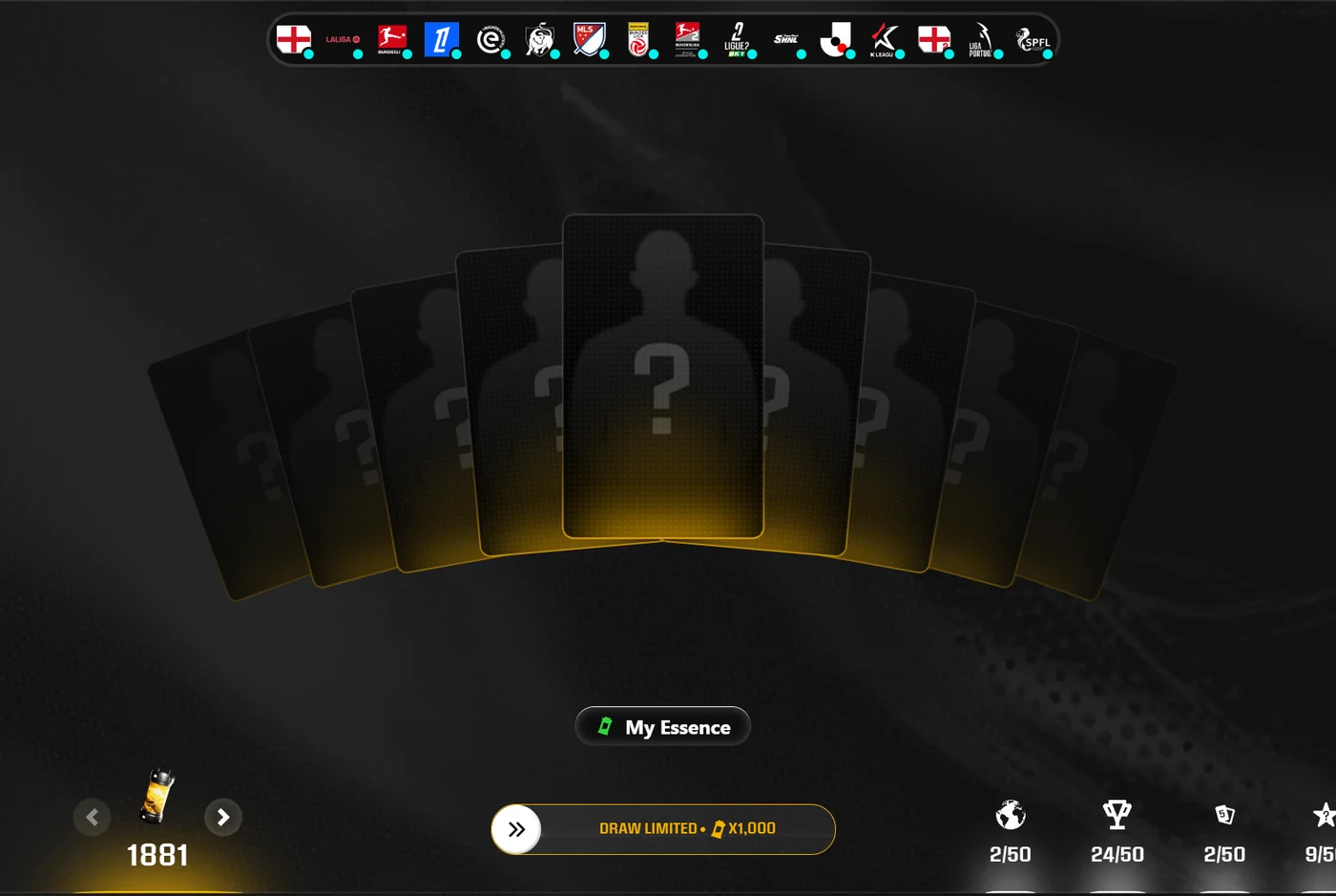
Essence is Sorare’s crafting currency. You can earn it through competitions, daily missions and other parts of the game, then spend it in the Factory to craft new cards.
At the moment, 1,000 Limited Essence buys a Limited-card draw. You are shown face-down cards and can use clues to narrow the field before choosing one. You might land a star; you might land somebody who mainly gives you another useful lineup option. Either way, it gives the game a progression loop that is not simply “buy another card”.
In the prize pool screenshot above, finishing 251st-350th in that English League Players Limited Arena paid 1,000 Essence — enough for a Limited craft.
In-Season vs Classic: what happens to old cards?
A current-season card is classed as In-Season. The biggest current-season prize competitions generally require at least four In-Season cards in a five-player lineup, with one Classic card allowed.
When the next season comes around, your old card does not disappear. It becomes Classic. Classic cards have their own competitions and are usually much cheaper on the market because they do not have the same current-season utility.
Classic Arena uses seven players rather than five, but the lower card prices can make it a very attractive route for somebody who wants to play the deeper version of Sorare on a smaller budget. Depending on the players you choose, you can sometimes build a perfectly usable Classic side for surprisingly little money.
Pro Mode: beat a score target instead of a leaderboard
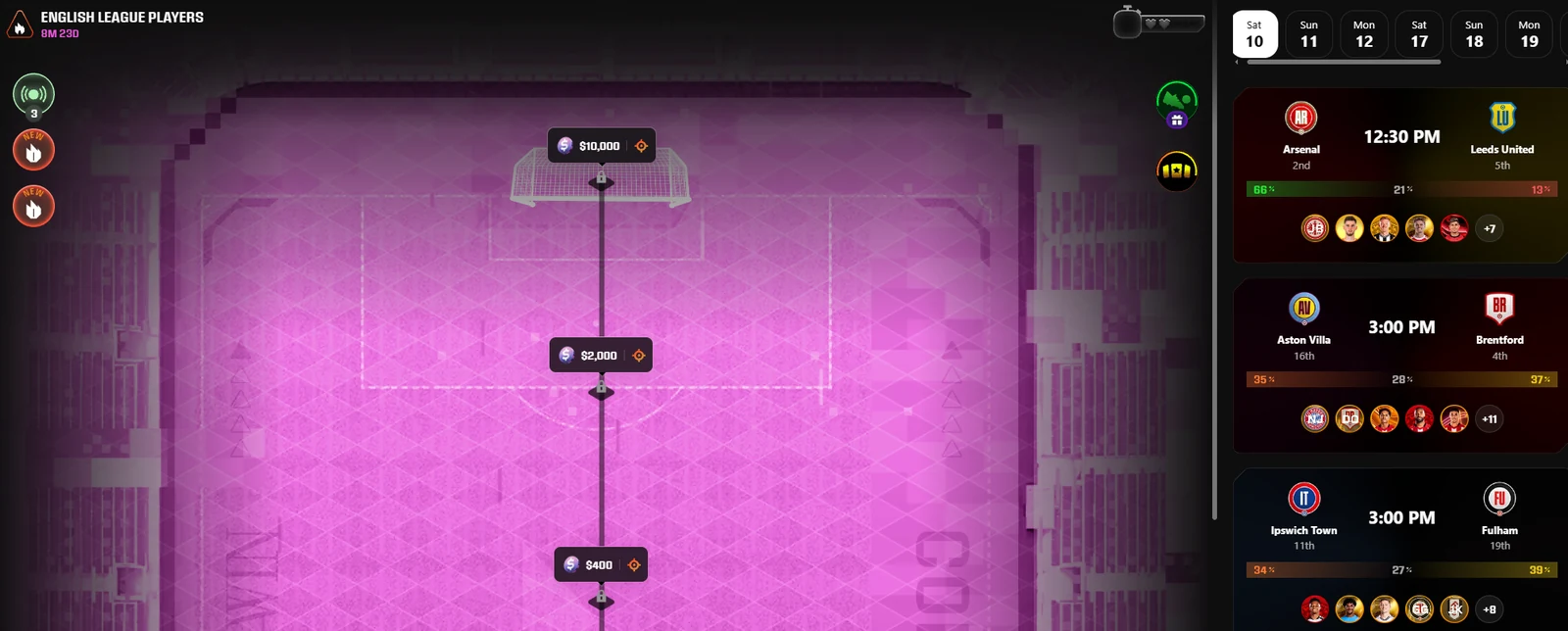
Pro Mode is for people who would rather chase a fixed target than worry about whether 4,000 other managers happened to have the weekend of their lives.
The current Hot Streak boards use a sequence of score targets. Clear one and you move up to the next step, with better rewards as you go. The top leagues also have a higher “King’s” challenge beyond the normal steps, with the headline reward reaching as high as $10,000 in the current structure.
You do not have to choose one mode forever. Some weeks your cards might suit Arena; another week you might prefer a Pro target. That freedom is one of the things Sorare does well.
So: is Sorare worth trying if you already play FPL?
I think so — particularly if the part of fantasy football you enjoy is actually evaluating players and watching matches rather than just reacting to price changes and captain polls.
Sorare is deeper, more complicated and potentially more expensive. That is the trade-off. But it also gives you far more ways to find an edge. Different player archetypes matter. Different leagues matter. Matchups matter in ways that a simple fixture-colour chart cannot capture. And when one tackle, pass or interception moves your lineup up a prize leaderboard, watching a random Sunday afternoon match suddenly feels a lot less random.
There is plenty I have deliberately not covered here: collection bonuses, XP, special editions, card levels, the finer points of the marketplace and a dozen other bits you will discover once you start clicking around. You do not need all of that on day one.
Start with the basic loop: get five usable players, understand how they score, enter a lineup, and see whether you enjoy it. If you do, the rest makes much more sense very quickly.
And if you want help deciding which Premier League players have the best upcoming matchups, start with our Sorare Projections & Rankings. We model the player’s own action profile, what the opponent tends to allow, and the match environment rather than relying on a crude “defence vs position” average.
Sorare can look intimidating from the outside. Once you strip away the card terminology, it is still fantasy football: pick good players, understand why they score, and try to be better than everyone else at spotting the opportunity before the match starts.