We called our GW10 update a fairly chunky one. Apparently we weren't quite finished.
The biggest addition to Fantasy Matchup Edge this week isn't another leaderboard or another button to sort projections. It's 550 permanent, interactive FPL player pages — one for every current Fantasy Premier League player — bringing together an enormous amount of the information we've been building across the site.
Current projections, Next 5 fixtures, historical performance, underlying actions, market movement, similar past matches and alternative players now live in one place. There's a new Price Changes & Ownership Trends tool as well. But the player profiles are the main event, so let's start there.
The big one: 550 FPL player pages
Open our new FPL Players directory and you'll find all 550 players, searchable and grouped by club. Each player has a permanent page — not a temporary Gameweek result that disappears when the fixtures roll over.
And these aren't just pages with a name, price and last week's points. The idea was to answer the questions you actually have when you're considering a player: How good is this week's matchup? What about the following four? Where does he rank? How does he normally earn his points? Is the market starting to move? And what has he done in similar circumstances before?
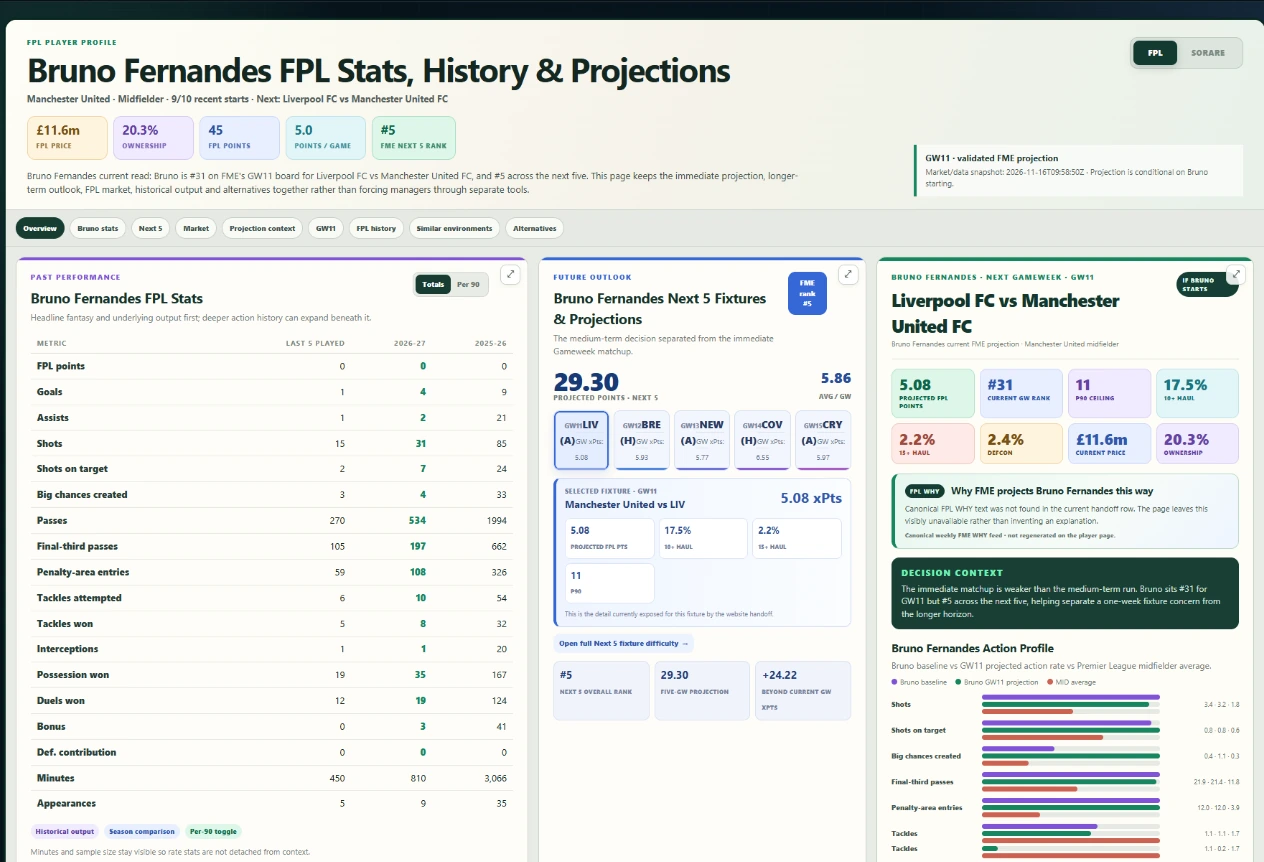
Take Bruno Fernandes as an example. His profile shows the current FME projection and haul probabilities alongside price, ownership, Next 5 outlook, action profile and historical FPL data. At the GW11 snapshot shown here, the model projects 5.08 points for this Gameweek and 29.30 over the next five, conditional on him starting. They're useful numbers, but the real improvement is that you can now inspect the context around them instead of hunting through several separate tools.
From one fixture to five — with the WHY underneath
Every profile puts the immediate matchup next to a fixture-by-fixture Next 5 projection. The coloured panels make the stronger and weaker numbers easy to spot without pretending that green automatically means “buy” or red means “sell”.
You'll also find projected attacking, creative and defensive actions, plus an FME WHY explanation where the evidence is available. That matters because two players can arrive at similar projected FPL scores for very different reasons: one might be relying on goal threat, another on chance creation, another on defensive contributions.
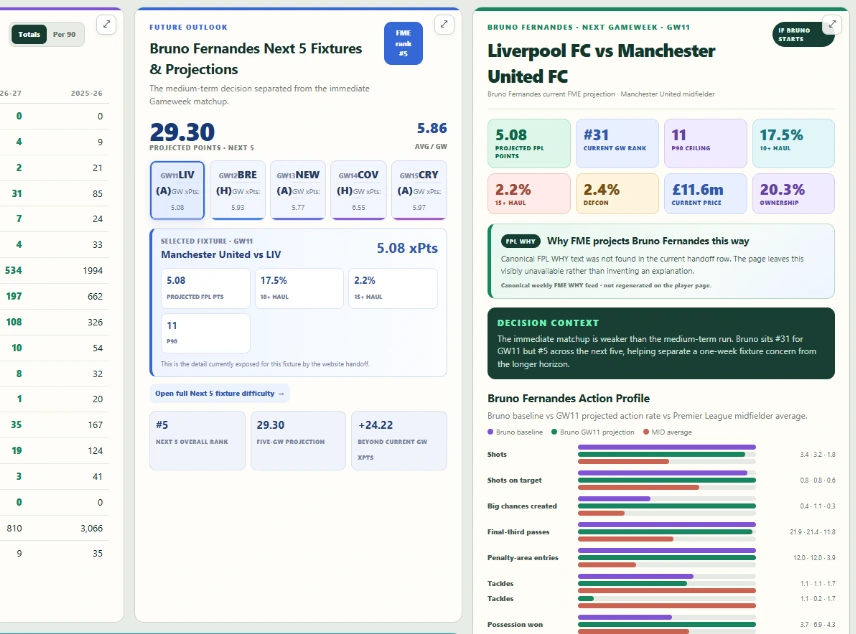
We're still using the same player-level model underneath. These are the outcomes of our matchup simulations, not a new set of predictions invented specifically for the player pages. And the current projections remain IF PLAYER STARTS — they don't promise a starting XI place.
The history is now part of the decision
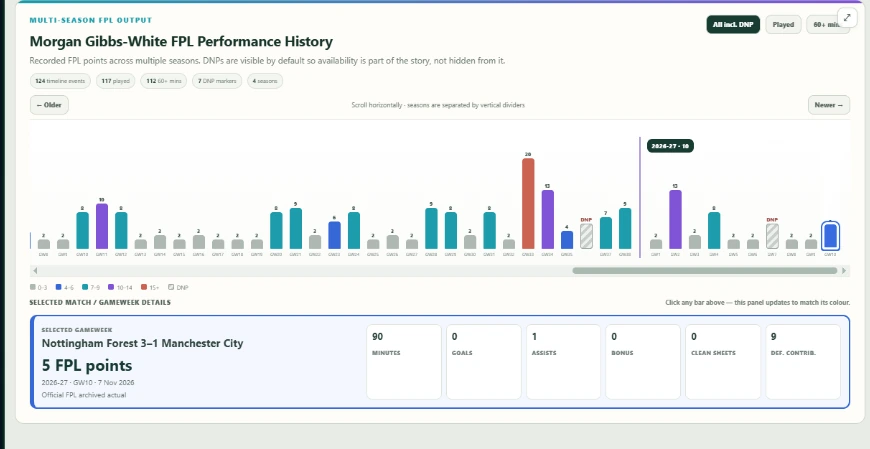
This is one of my favourite additions. We've added an interactive, multi-season FPL performance timeline covering the available data from 2023/24 to the current 2026/27 season. Instead of looking only at a handful of recent totals, you can move through individual Gameweeks, inspect points and minutes, and see the circumstances of particular performances.
There are filters for all appearances and DNPs, matches played, and games with 60 or more minutes. That's useful when you're trying to separate an ordinary blank from a match where somebody barely got on the pitch. Obviously, players don't all have a full four seasons of FPL history; the timeline shows the history available for that player.
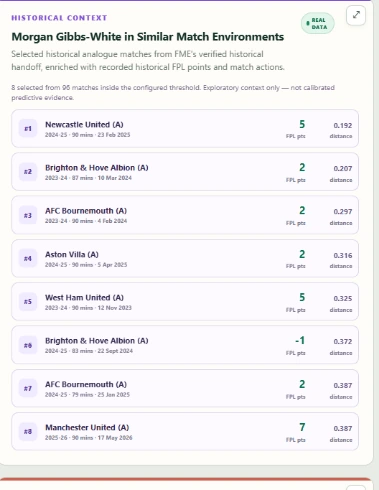
And then there's a feature that feels especially true to the FME approach: Similar Environments. For the player's upcoming matchup, we can surface past matches with an environment resembling the one he's expected to face now. It's a way to ask, “What happened the last few times this player found himself in a match like this?”
It's not a second prediction model or proof that history will repeat itself. It's exploratory context — useful evidence to look at alongside the actual forecast, rather than a reason to assume that a previous two-goal haul is about to happen again.
Price and ownership: the other big new tool
We've also launched a dedicated FPL Price Changes & Ownership Trends page. You can track the direction of player prices and ownership across the season or over shorter windows, check the biggest risers and fallers, and look up an individual player's history.
Its default view is This Season, because a broader view of what has happened to a player's price or popularity is often more helpful than the last few days alone. The profiles now pull that market context in too, so you can consider the football projection and the market's behaviour together.
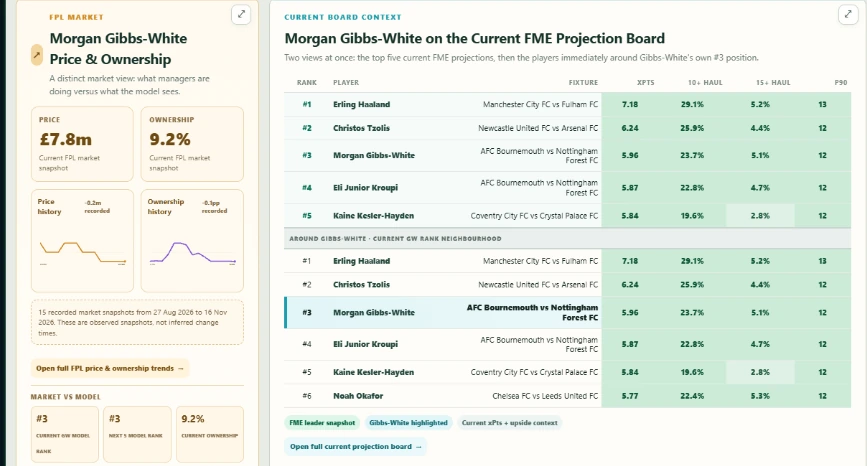
One important distinction: these charts show observed snapshots. We're not claiming to predict tonight's FPL price changes, or to know exact transfer counts from changes in ownership percentages. Popularity is interesting; it isn't automatically evidence that a player is a good pick.
Finding the next option is easier, too
The player pages are now connected throughout FME. See an interesting name in Predicted Points, the Next 5 view, DEFCON, Captain Picks or Player Comparison? You can open their full profile directly. The existing detailed EXPLORE pop-outs are still there separately when you want a quick look at the current matchup.
And here's a particularly useful shortcut: profiles suggest alternative players. Hit the Compare option and Player Comparison opens with the original player and those alternatives already loaded. No more re-entering names just to find out whether that cheaper midfielder is actually a better fit for your team.
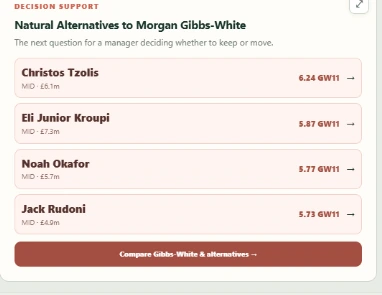
So the workflow becomes a bit more natural: spot a player in the projections, open the full profile, inspect the past and future, look at similar environments, check the price and ownership history, then compare the alternatives.
Give the new player pages a go
The 550 profiles also have permanent, indexable addresses, so you can bookmark a player and come back as new Gameweeks arrive. With the searchable directory, that makes FPL Players a proper destination in its own right.
We haven't replaced the bigger tools, and we certainly haven't solved football. We've tried to make the research much easier to do in one place, while giving you more ways to question the projection rather than blindly accept it.
Start with the 550-player directory, pick somebody you're thinking about buying, and have a look around. You might find a brilliant matchup, a worrying historical pattern or a cheaper alternative you hadn't considered. And if the model loves a player who then scores two points, well, at least you'll have a decent amount of evidence with which to argue about it.